Monday, 28 May 2012

Senses on Site


The work has become more and more about the momentary reaction when the space becomes a place for the performers, the passersby and the spectators. “Calling spectators attention to the neglected minutiae of everyday” 
(Siegel, 2007: 2)

For the performers, we have worked with different places in London to see how their bodies change and react to the environment which normally they would ignore; these motifs they each created have been used in the choreography within the work.
These motifs gave an insight into how each individual relates to sights, listens and experiences in very differing ways. From Primrose Hill, to the Tate, to Liverpool Street, I have notice each of my dancers’ relationship to the city.

Working with the way we see:

Alice creates motifs that are inspired by the distance landscape; she sees the whole and the objects that are far away. Her motifs have been inspired by this as she is very open and vast with her movement. This is Alices motif of the bridge in the distance, she described how she wanted to feel the vast and strong nature of the construction:


Sarah looks at the layers of the sights, she picks up on shapes and how they fit together and on top of each other. Her movement leads into motifs that abstract and quite angular. Below is Sarah amidst a transitionary motif which explores the view of 3 bridges stacked up in her view: 


Michelle, who recently had to leave the process due to study commitments, was very individual with the way she worked as well. Her movement was directed towards objects and sights that were immediately in front of her, this meant that she created positions that were am personification of the object. As you can see in this picture below, Michelle was attempting to become the life ring:


Chloe, who is a new addition to the process, created motifs that were rather inquisitive; she looked for sights that were hidden or not something you would usually glance upon. This changed her whole body as a response to the motifs.

As I made motifs, I seemed to go for sights that moved, for example the birds, the trees, which influenced my movement with flowlier, circular based motifs.

This was also apparent when we moved in response to the aural sense: Sarah moved to the rhythms of the city, I found myself directing my movement towards the origin of the sound, Alice created a duet with the sounds and Chloe again heard sounds that were not as noticeable.
I have also noticed how the senses go beyond just the five we immediately think of (sight, aural, tactile, aromas-taste&smell), but rather it can relate to temperature, or pressure. As all rehearsals are on site, I have been able to see the change in movement when it is cold and dark to when it is bright and sunny. The movement is far more explorative and open from all the dancers when the weather is warm, which in turn will affect the spectators and passersbys reactions...

This immediately affected my work, because if 5 people experience differently, I began to think about the passersby and spectators, and how they are likely to see in individual ways too. My work is supposed to invite people to stop and realise or just experience how this space appears to them, in order to make it a place for them – however this would be difficult if I presented the space through MY response to it.
Therefore, I wanted to make sure that the work was accessible and experimented through different avenues of movement. I decided to incorporate the motifs that the dancers and I have created around London into the work, because not only does it respond to the senses in different ways, it also relates to the idea of the transformation of a space to a place. The motifs have seen an alteration in the way my dancers move, they have began to move through an organic response to the environment rather than through their skill set within dance. Through doing so, they have created individual relationships to that space, thus turning it into their place.
The idea an authentic movement resonates with my work, as it asks of the individual to relate to the sight through their unconscious desires, instead of socially constructed ways of seeing. So, for example, we walk to work using our bodies along the frontal plane, via routes that are directed to us, allowing our experiences to be limited. 

Now, authentic movement allows us to create an individual connection to that space; Pallaro discusses how, through experimentation with movement, one can create a dynamic relationship to an object or space in my instance, creating a “sense of congruence with self and other” (Pallaro, 155). Therefore, this authentic response to movement can create an individual relationship to the environment for the dancers.

Now, for the passersby and audience, the movement is going to be placed in different areas around the site, asking them to step out of their everyday patterns of movement to have individual choice over how they want to relate to it.

Do they want to stand close to the movement, do they want to step back and see the work within the backdrop of the city?

Through improvisation, will the spectators, relate, and in doing so, move towards the movement that connects to the way they relate to things? E.g if a dancer is improvising around something directly in front of them, will someone who sees similarly move towards this dancer?

Bibliography

Siegel, M. B (2007) Dancing on the Outside. The Hudson Review, [online] LX (1) Available at: http://www.hudsonreview.com/siegelSp07.pdf [Last Accessed: 01-05-11]
Pallaro, P (2007) Authentic Movement, Volume 2: Moving the Body, Moving the Self, Being Moved: A Collection of Essays. London: Jessica Kingsley Publishers.

Site in the Site Work...


I have been lured in by different books presenting ‘site-specific’ in the title, leading me onto ‘site-specific’ artists, such as Lucinda childs, Meredith monk, Allan Kaprow and Trisha brown. Who’s work have really inspired me to look at framing in the city and the merging between life and art...

Trisha Brown’s aptly named performances Walking on the Wall (1971) and Roof Piece (1971) inspired me to relate to everyday objects in a city space in unique ways. Through working with distance the piece really made me look at the space in a new way, and I was only able to watch this online... therefore, it got me thinking about what it must be like in person. This made me become a lot more inquisitive and explorative when I visited the space for performance – looking for areas/objects to be transformed.

However, this site-specific works I have been resonating got interrupted by Robert Irwin’s distinctions between different site based art, of which ‘site-specific’ seems to have become the fashionable term for all site based approaches.

Irwin describes Site Specific as “conceived with the site in mind”*; however work done this way isn’t necessarily focused on the context or understanding of the site.

Now, often performances are Site Adjusted – this is works which are inspired by the site, but created in the studio and then taken back to the site.

I feel my work lays more under the title of Site Conditioned/Determined, which Irwin describes as work which "draws all cues from its surrounding”*; therefore the work needs careful consideration and understanding of the site. As my piece is created and performed on the site, I will now refer to my work under this title.


*Irwin, R (1985) Being and Circumstance: Notes Toward a Confidential Art. Lapis Press

Improvisation vs Choreography


The presentation of my work became a question mark...?...

I was thinking of different parts to base the choreography on, and then I questioned why I would use choreography? My work is based on being responsive to the environment in that moment, and choreography would not only be MY representation of the environment, it would restrict a connection to the surroundings for my dancers.

As discussed previously in “Senses on Site”, I become aware of how each dancer has an individual relationship to their senses, but how could I present this through my own choreography - as it would be stuck in my own relationship to the surrounding?
On the other hand, the motifs that my dancers have created around London and on the present site, have been a trace of that space transforming into a place.

This concept of trace has been something that I keep returning back to. Derrida discusses how each present moment is a trace of the past and the future, a kind of continuing stand of changes. For us, not only have we rehearsed at different times of day we have done so in differing weathers, really pushing our motif development.

Also, during a psychogeographic workshop with Laura Oldfield Ford (http://lauraoldfieldford.blogspot.co.uk/) around London, she discussed how each area is embedded with traces of what was. Therefore, my work is a trace of what was the progression of their relationship to that space, and other spaces around London...

These motifs became essential to the work, as I was edging towards the idea of spaces into places more and more. However, I also need the piece to be very open to interpretation and adjustment by the dancers, because I can’t expect them to wake up the passersby and spectators if they are just performing movement... However, this piece of choreography will be embedded in their bodies and allow them to stop/adapt moments on the spot, allowing the spectators/passerby to see them being an individual within a collective – which is what I am inviting watchers to do!

As I played with flocking and improvisations in my workshops, I could see stunning moments of perceptual awareness, where the dancers were engaged with each other and the surroundings as they experimented with working close together and far away in fast moment to moment decisions. This is discussed by Di Benedetto in relation to contact improvisation; how proximities can push the dancers relationship to their senses: “The form depends on communication between dancers through the sense of tough and weight. Dancers use sight peripherally, not in eye contact” (Di Benedetto, 2010: 163). In turn, this really invited me as a watcher, and hopefully the spectators, to want to connect with the dancers but also what they were responding to. ..

For me, I think the idea of an improvised piece was unpredictable and unstable, which scared me, however, as I saw how organic and responsive their movement was, I started to realise that unstable was what I needed to wake people up!

The motif development has been an improvised way of devising choreography, which has been successful so far, therefore, I will be working with creating a score that allows individuality, and reconstructs a view of the city, by the tools provided by dance: levels, pause, speed, dynamic…

Di Benedetto, S (2010) The Provocation of the Senses in Contemporary Theatre. Abingdon: Routledge

Monday, 14 May 2012

Waking up my dancers on Primrose Hill


So my first process up to the festival is waking up my dancers.

I can’t expect my spectators to be engaged with the surroundings if my dancers aren't.

They have all taken part in workshops which involve connecting with the senses and creating relationships to spaces through tuning scores exercises. However, due to practicality a lot of this has been done in the studio.

However, this beautiful Friday evening was the perfect time to take them out and see the beauty of the city.

I want my dancers to create their own vocabulary to the city through their senses. So my plan is to take them to different places around the city and carry out similar exercises so I can understand how they individually connect to their senses and the sensoral offerings of the city. I think it is important for them to be part of my choreographic vocabulary because the piece should not be my representation of the city, but a group of individual relationships. Especially as my piece invites the individual to engage with their OWN London.

I took two of my dancers to Primrose Hill.
We started off with a walk; I sent them off individually as I wanted them to think about how they related to this space through their senses.
One dancer related mainly to the sights, which isn’t uncommon because, the city is controlled through the visual via advertising, directions, brands...
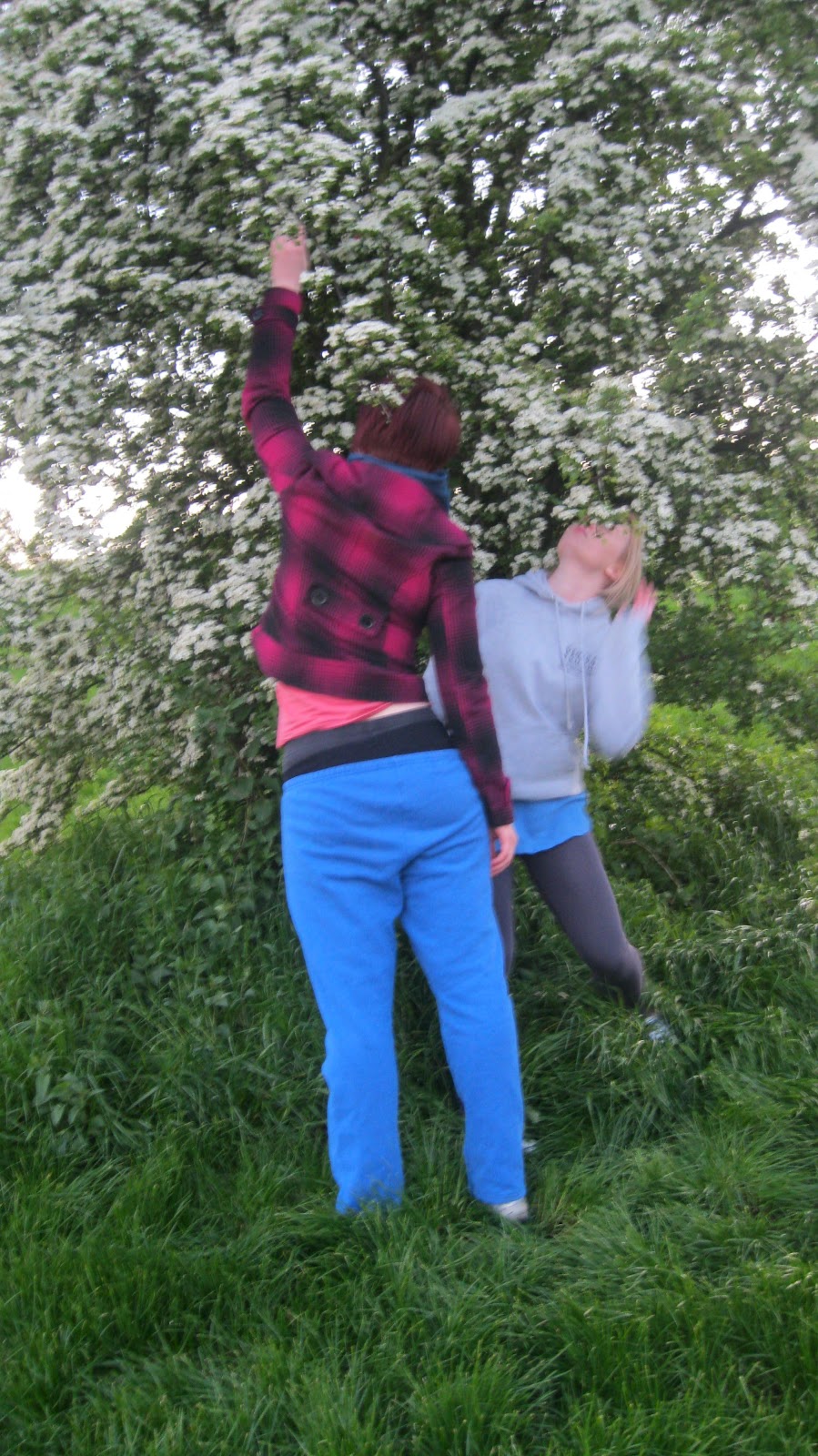
My other dancer connected to the smells, she explained that because the trees were blossoming it was a smell that stood out to her, as a contrast to ordinary city smells. 

We followed this with a tuning scores exercise, as I wanted them to see the little within the big, and really start to connect with the vast areas of the outdoors, rather than the confined space of a studios. I really wanted to move them out of their comfort zones and see them really connect through an improvisation task. We started with sound, and we all moved with this as our inspiration. The brief was:
Move like the dynamics of the sounds
Move as if you are embodying the sound
Move as though you are creating a duet with the sound
I wanted them to let they body control this relationship.
They then created 3 motifs which embodied this idea. This was then their relationship to the soundscape through movement. 


In Michelle's (above) the middle was static and the top and bottom were moving. She started off already very engaged through her performance of these senses, which was exciting, however, her movements were all quite jazz based.


With Sarah (bottom) Her first two were moving and her last was transitioning. She really tried to encapsulate the different dynamics of sound she heard through the style of her movement.

The both moved towards the sounds of laughter and quiet, and created edgy movements directed towards the loud cars driving past. However, as there was a very distinct contrast between the two sounds there was not much more within the soundscape to relate to.

We worked to link these together as a transition and as a finally development they performed these together, and this became a trio, Michelle, Sarah and Primrose Hill Soundscape:


This was a beautiful piece of installation, where they both worked together and individually with the soundscape of the city.

Essentially, that is what I am inviting the city people to do, be part of the London community, but at the same time, have an individual relationship to what it is offering.

They ended this with creating an individual motif to the sound improvisation.

We then did the same exercise for sight. This one was very interesting, as there was much more in the visual landscape on offer, so I could begin to see how individually, we see or engage with the surroundings.


Michelle chose:


A big white angled crane


A cloud which looked like it was shooting upwards


The trees in the distance


Sarah chose: 

The people sitting on the hill -->


Flat bottomed clouds 


The boxy shapes of the buildings

As we progressed I saw a change from movement that was not so much guided by their comfort zone within dance, but was movement that was their gut reaction to that sense.

I was a development in the way they were relating to senses, they were exploring different connections, whether it be becoming that sound, contrasting it, embodying it or playing with it.

This then saw a change in the execution of these moves. Their eyes became more engaged, from this I became more engaged watching them. I found myself wanting to see or experience what they were experiencing, as I wanted to feel this engagement.

This was it!

We ended with Aromas, I took out the tactile sense because it began to get really cold and I felt this would affect their movement too much.

Within this improvisation their movement, really began to play with the aromas of the trees and with each other, they were becoming more playful and enlivened through their blossomed relationship to that sense:


This was the start of my piece. My dancers were really beginning to wake up to the city, and create relationship to their surroundings through all the senses that were on off.

The movement was about their relationship to that sense, they were using the dance abilities to allow them to articulate this rather than it being their stylistic outlet. Also, their facial expressions were a natural awareness and an inquisition into their surroundings.

Primrose hill was no longer a pretty space; it became a place for each of us.

These motifs will be added to a bank of movements that I collect with my dancers from different areas around London, and I will then put these positions into my choreography. 

To end the workshop, we performed a piece of choreography that they have both done a few times. I wanted to see how they presented a sequence that they knew, so they could concentrate on their new found relationship to the city via Primrose Hill.

I could see them becoming aware of how they relate to their senses and how they could translate this through movement. Michelle's fascinated eye, transformed the choreography into a duet with the visual. 

Where as Sarah, was allowing herself to engage at different moments, to the gravel as when her head lowered, and then to a spot in the sky, making her articulation of the movement very detailed and interesting.

Now, Primrose Hill has a lot of nature to offer the senses. Now will this become more difficult in more industrial areas, where there are a lot to offer the senses but are sometimes discussed in a derogatory way.....

M.J.B

Monday, 30 April 2012

Waking Up London Bridge

I decided to take my work onto London Bridge at rush hour, as the place for my first experiment for 'Waking Up the City'.


I carried out some workshops with 4 dancers around opening up the senses. Before we could go out onto the Bridge I wanted my dancers to be perceptually aware whilst performing in order for them to be really present in their experience with the senses.


I adapted some exercises from Lisa Nelson and Viewpoints. I included a lot of walking around the studio, with changes in direction, levels, speed, asking them to concentrate on different senses. The workshop provided a development into perceptually aware movers, whereby they were able to really tune into all their senses by building this strong relationship to the space.

The walking carried through into the choreography, as the piece was going to be on the bridge alongside a fast moving traffic of people. We did exercises using improvisational techniques, such as exaggeration, retrograde, size, quality, and change of planes, which would help us understand the body on the bridge and also how to completely reverse it. 


We also did a flocking exercise, which is inspired by the group dynamic of birds, where there is no leader but a heightened sense of when to move. This exercise really exaggerates the notion of the stampede seen on London Bridge, but also contrasts it by demanding the group’s full perception for it to be carried out effectively, for this reason I decided that this could be a useful exercise executed on London Bridge, hopefully showing people an organic, unplanned relationship to the space and the senses, that ignores the ‘status quo’.

Another exercise I wanted to carry out on the bridge was a choreographed piece, guided through the space by the senses, with specific gestures that interrupt the ‘urbans'.

Here was the first attempt of waking up the city involving both these exercises: http://www.youtube.com/watch?v=L8VgKeQniBs


Here is a few pictures, for more, please see my flickr account:  
http://www.flickr.com/photos/77909775@N02/sets/72157629211328350/


The filming and photography was done by James Booth.

The choreography for the first piece was done in the studio, where I worked with contrasting pedestrian movement with stylistic expression that crossed different planes of the body. I also worked with shifting through the senses, by incorporating touch, pause and different speeds, so the dancers could have a dynamic relationship to the space.

The piece involved quite rather evident gestures, such as ‘come here’, inviting the audience to look at the view. I then went onto London Bridge on my own, where I could adapt the movement to really fit with the sensorial offerings of the Bridge and the flow of the ‘urbans’.

When teaching the choreography to the dancers I chose to do it in the studio, this was because for 2 of the dancers it was the first time we’d met and I wanted to do some exercises that worked with opening up the senses, so they could understand the essence that I required in the movement. Also, it was important that when they performed it, they would really feel the transportation from studio to site.
For both of these pieces, I felt more time was needed for the dancers to really engage with the senses, and be rather than just performing movement. This was evident in the flocking, it asked a lot of the dancers to create a new expressive relationship to the surroundings and to the group, really pushing their senses and perception, which often got lost to self-indulgent movement or to a leader that guided rather than working as a whole. This piece ended up being more beneficial as a task for the dancers, rather than for the passersby. The piece was rather alienated from the ‘urbans’ as it was orientated around the dancers and their experience. However, what I really found worked, were the beautiful movements where the dancers found instances where they were experiencing themselves and the surroundings.

I would like to work even more with senses, and develop a greater relationship to the bridge I use for my final project. I invisage having moment where the dancers are interweaved with the spectators and they stop and look, or touch or react to the senses which are usually ignored, tempting the spectators to do the same.

M.J.B

Tuesday 20th March


Wednesday, 29 February 2012

Mind-body and the tube...


My notion behind my first workshop was to be able to really understand the mind-body perception of space in the tube. After my journey around the underground, I was able to see that people became a ‘tube’ version of themselves, whereby they limited their desires and acted in such a closed off manner that they ignored all the opportunities the senses had to offer.

Ahead of time, I had asked my performers to notice 3 things about the way they routinely sit when on the tube. Aptly, we met on the tube on Thursday 23rd February. On the way to the studio we began to individually spectate the comings and goings on the tube, and tried and pick out common behaviours.  The second half of the tube journey, I wanted the performers to just sit in their comfortable position and just try and act as normal (as they can). I began to notice how they blended in to the aura of the ‘asleep’ tube...

On arriving at the studio we began to discuss what we noticed, they seemed to recognise similar happenings that I discussed in my previous blog (women holding their hands at their stomach, how the tube traveller positions themselves as to avoid eye contact...) We started to understand how men have a more open chest on the tube, where as women seem to invert their chest and cover their stomachs.

Into the studio, we did some tuning exercises, inspired by Lisa Nelsons ‘Tuning Scores’, Miranda Tufnell’s ‘Body, Space, Imange’ and Anne Bogart’s ‘Viewpoints’, here’s a snippet of what I did:

Firstly we lay down in a comfortable position, letting our body sink into the floor, releasing all the tension. We isolated the senses taking time to really hear, smell, taste and touch (no sight at this point – eyes closed). We started moving, letting the body be inspired and guided by the senses, taking time for each sense separately. I sped this up and slowed this down, really letting the body move instinctively to the sense.

Straight after that we did a Skinner Releasing exercise, [http://www.skinnerreleasing.com/] which works by 1 person standing with their eyes closed [A] whilst the other person brushes their body along lines of energy [B]. B stands perpendicular to the A, with their hands placed one on the stomach and one on the lower back, B brushes the body, going up the chest and down one arm, and carrying the flow of movement out into the space, this is repeated on the other arm and down the legs. This is a performance in itself, B is really moving around the energy of A, taking the energy out into the space. When this is finished, A opens their eyes and walks around the space. This exercise works to relax the body, and also really open the bodies energy into the space, creating an urge to move organically.

I then took this straight into a Viewpoint inspired exercise; as they walked around the space they then were directed to walk towards an object, marking or sight that caught their eye, and make their way over to that area in any way they desired. Did they feel the need to take time to slowly shift to that place, or did they feel the desire to run at it? We worked with different dynamics and levels as this exercise developed.
I then finished off the studio work with an adapted tuning scores exercise, which was based around the following instructions:
 ENTER Enter the frame
PAUSE Suspension in stillness
FIND find the first thing you see
OPEN / CLOSE Eyes open, eyes shut
NEXT Cut do something else
RESITUATE Change place or point of view
REVERSE Revisit the experience backward
SUSTAIN Sustain the present activity
EXIT Exit the frame


This saw the performers really becoming curious to the space around them, really being present in the exercise, pertaining to the space around them.

We then took the workshop into the tube, and immediately noticed the advanced nature of our presence on the tube; we all started to be aware of how much we have been ignoring and ‘blocking out’ on our daily travels, especially colours and sounds. There was a plethora of sounds, at different distances, that we had previously disregarded. The studio work had been able to give us a glimpse of how aware and curious we could be.

We then began to get comfortable in our ‘automatic’ tube position, being aware of the 3 things that we all found prominent in our bodies when on the tube. Feet, hands and back were part of most of our prominent ‘tube’ features; we discussed how we adapt our body for security, to shy away from the surroundings. Our bodies also work to appropriate, minimising our desires in order to stick to the status quo, e.g keeping our feet close to our bodies instead of spreading them out. We began to look at how these positions affect the rest of our body, physically, looking at the structure of the bones, what part of the body is stable compared to something that is freer. We also looked at how these positions affect our perceptions... because my head is down; my eye sight is compromised and restricted, is this also to fit to the status quo? How does this change my reactions, because I am more closed, how would I act if someone brushed me? How do I see myself in the space? How do I relate to others in the space?
We worked with improvisations to exaggerate the positions, isolating them and working with the whole body. I wanted to understand the ‘tube character’ that this position creates. Are you claiming a space? Are you hiding away? Really becoming aware of how the body encompasses these feelings. A lot of tube positions seem to be guarding the body against the fear the tube presents. Especially since 7/7, we have become even more insular, funnily enough we have not become more aware. Possibly we are living up the old saying ’ignorance is bliss’, if we forgot how horrible the concept of travelling underground is, we can get through it safely.

Therefore, this posed the question to me, if we are very nervous of other people, how can I attempt to wake up the city traveller without being perceived as threatening?
From this workshop I was able to see and be apart of really understanding what happens to the body on the tube, as we went from heightened senses, into a ‘tube you’. The exercises really invited us to experience the tube; however, it was very easy to slip into the comfortable/safe tube state once we started to do so. I wanted to explore the body-mind connection, and I think I am beginning to understand how the body guards and appropriates your character and desires for the tube, and with this it beings to restrict the way we perceive. With my body, my back becomes very curved, with my hands crossed on my stomach with my elbows on the arm rests, and my legs are always crossed. As I began to explore this, I noticed that I was claiming my space with my elbows and my knees directing outwards, but also hiding away with my hands on my stomach and my head bent over. I think this is a classic positioning on the tube, we don’t want confrontation but we also want a much of our own space as possible, and therefore we close off, not opening up our senses to look explore the space, as that could interrupt someone else...
I began to think about how the tube has limited offerings for the senses, there is a lot to hear, but there isn’t too much diversity of sights, and there isn’t much to smell other than other people. However, on London Bridge, the bodies acted in a similar way where their direction towards home was direct and strong, but there was a strict status quo. Diversely, London Bridge has a lot to offer for the senses, smells of the river and the central City, sight: high rises, Tower Bridge, the river, touch: the air on your skin, other people, weather...
Therefore, the next step seems to be to understand the change in London Bridge between rush hour and the afternoon, do both groups of people seem closed off? How can I create a workshop, similar to the tube to understand the ‘London Bridge’ traveller? Then, potentially, how can I create a performance in the space that really asks and invites the spectators to question their state in the city, and prospectively be more than a momentary manipulation of the sense...?

Bye.
M.J

Wednesday, 22 February 2012

Understanding the asleep city...

A little bit of background to what I am doing, I want to attempt to wake the city up. So first of all I went on a journey to understand how city bodies negotiate their way around the space....


I chose to explore the tube during rush hour yesterday. So in the morning I went on a journey from Willesden Green --> Waterloo --> Tottenham Court Road -->Bond Street --> Swiss Cottage. My attempt was to explore the body through Laban Movement Analysis, which looks at different unconscious styles of action the body exudes that mean different things about that person.


Basically, I found this rather redundant in 2012 London because technology and space has adapted the way we hold our bodies, for example we curl over our phones, but this doesn't necessarily mean we are being indirect....?


I also attempted, to smile at people, I use the word attempted because gaining eye contact was hard enough. There are patterns of intricacy that appear on the tube whereby people place themselves in such a way that their eyes cannot directly contact someone else's. My results were dim....


After a 45 minutes journey, 10 people looked away when I smiled at them, 7 people gave me a awkward half smile, 2 people gave me a half genuine smile but away straight afters, as if something x-rated had just happened...

FINALLY, I got a smile...OK, I only got a smile because I gave her my seat, but still.... it was something.


So, in the evening I went out again, but this time I wanted to just write, ironically, I took my iphone to write on.... but that is a whole other story...


So here we go, this is my account of my journey on the tube from Swiss Cottage to London Bridge 5.15-5.45...


As I start to analyse the sound of the tube, I hear thunder, I feel big rather than intimidated, I feel large with the sound of the air, I feel close to the winds.

I pay attention to the way I sit,
With my legs automatically crossed, how did they get there? At what point do I throw my left leg over my right?
My elbows stretched across the arms of the seats. My shoulders automatically lift up because my posture doesn't change to adapt to the spacing of my shoulders.
I begin to notice my posture, naturally curving over ready for me to play with my iPhone, read a magazine or clasp my hands across my stomach.

Do we ever realise how we sit? As I begin to think about how bad my posture is, I want to re-align, my shoulders feel tense hunched up and I dont like how my legs are crossed. I feel closed off and restricted, do we even realise how much me inwardly direct ourselves?!

The woman's stomach, our bags are automatically sat on our laps, like a precious stone that we must guard, our hands, again, automatically shielding it with a slight or small grasp. If there is no bag at our stomachs, women seem to sit hands pressed together, guarding a stomach, guarding themselves? Are we self conscious? Has the media even changed our natural bodily practices to hide our, what the magazine so eloquently named  'our problem area' or ' muffin top'...?

Our eyes, staring, they stare, at anything but a human. We will make contact with the words on a page, the iPhone, anything but the people around us.

My journey is enlightened by the family with the small child, they are attentive, protect but also happy, involved, really bright, and this illumination is inviting as they sit and entertainment the wondering and inquisitive eyes of the child. The child, the unconditioned curious child, their big eyes negotiating with the space, excited to learn, happy to stare into the eyes of another. The family, who fill the bland silence by answering the child's futile but curious questions with loud and animated responses.

The sea of evening standards cover the eyes, shield the tube travellers from the possibility of engaging in an awkward glance with another.

The men of the tube are more open, the legs wide, their chests uncovered by hands, not bothered by the possibility to someone stealing their stuff? Or possibly open to criticism, unlike women? Possibly not as conscious, nothing to hide...?

The tube begins to fill and my largeness I felt earlier suddenly becomes filled with bodies and newspapers. I am sitting down and I feel intimidating

"I'm waiting for an appointment to have it cut out..." I hear this loud conversation between two people and it breaks my previous thought. My natural urge to be nosey invites me in to wonder what they're talking about... A lump? Her hair? Her hair in an unfortunate place...?

The women wearing their trainers, do, aptly for the military like nature of the tube...


I then travelled out onto London Bridge....
The sounds of different conversations float into my ear as I walk past, different accents, languages. The sound of talking is invited by my ear after the awkward silence of the tube.

The racing start at the traffic lights, the bikes prepared at the front of the race, the cars bellowing behind them like an animal about to chase it prey.


I cut across the herd of people walking across London bridge, my senses are alivened, similar to when you are about to fall or someone may hit you,  I am suddenly fearful of these angry walkers. They have an intention, they aren't dawdling, or even looking over their shoulder to glance the beautiful views that London has to offer.


I meet this man from New York, he startles me, I was so lost in watching other people's movements. We get to talking, I invite him into my current awareness of the London Bridge stampede...


"New York used to be like this" he answered in response to a statement I made about how the rush hour workers ignore 
each other and the beauty of the city. He goes on to state how New York is more communal after 9/11, people are more friendly, possibly sharing a nod or a smile. Does it take a disaster to open up people's senses, to awaken people to their existence and how they are not too dissimilar to the other people that share their space?


I started thinking about 7/7, but what seems to have happened is that it wasn't big enough (horrendous as it sounds) to really affect us. Instead, it made us even more inward, even more fearful...

So this is where I leave you.
My first blog, now I'm off to turn this into a rehearsal process to understand the body in spaces...


Bye.
M.J